MBA in Ireland
Table of Contents
- Why Pursue an MBA in Ireland?
- Top Universities for MBA in Ireland
- Popular MBA Specialisations in Ireland
- Eligibility and Admission Requirements for MBA in Ireland
- Tuition Fees for MBA in Ireland
- Top Scholarships for MBA in Ireland
- Intakes and Application Timeline for MBA in Ireland
- How to Apply for MBA in Ireland
- Student Visa Requirements for MBA in Ireland
- Top Cities to Pursue an MBA in Ireland
- Top Job Opportunities After MBA in Ireland
- Conclusion
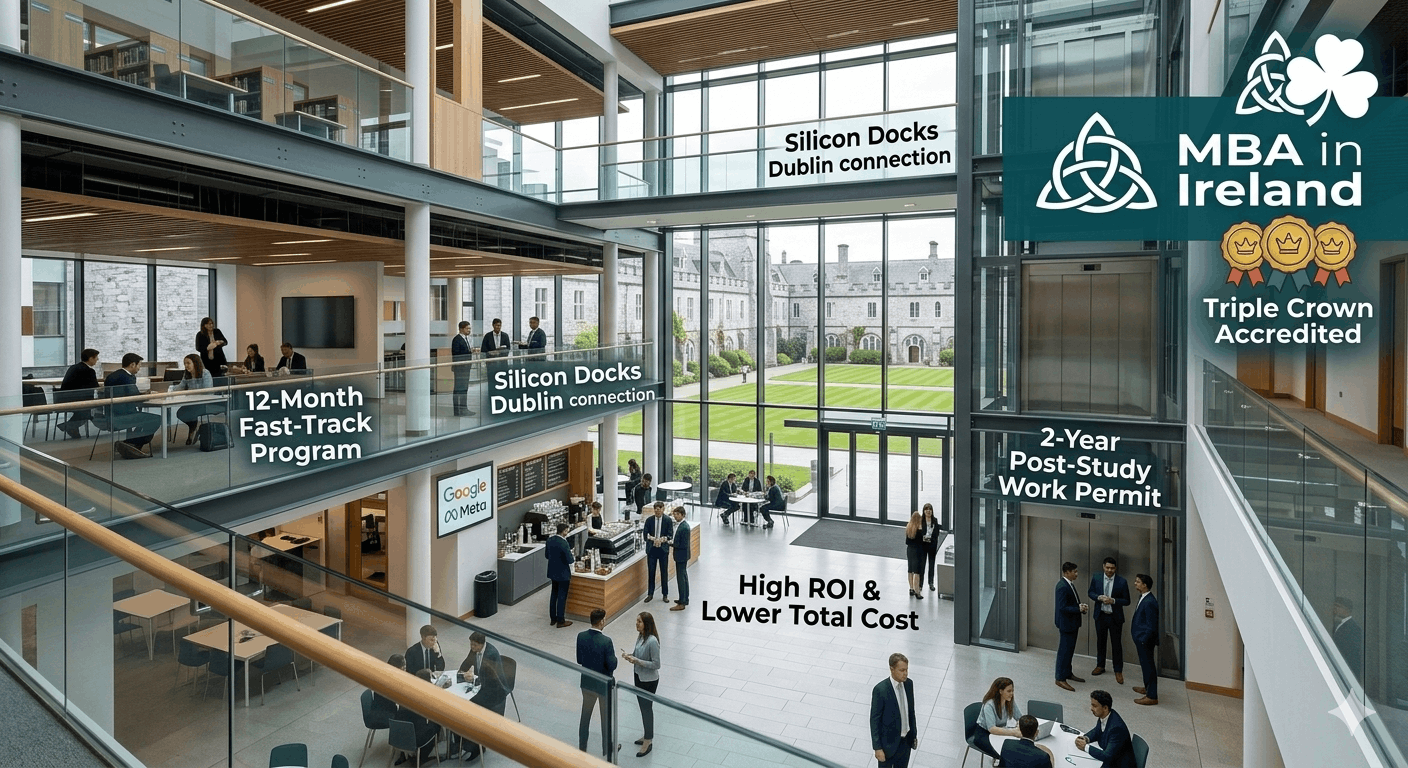
An MBA in Ireland is a popular, cost-effective choice for international students looking to study within the EU. Most programmes run for just one year, considerably shorter than equivalent degrees in the US, while non-EEA graduates can stay back for up to two years under the Irish Third Level Graduate Scheme. Trinity College Dublin holds its strongest ranking in a decade at 75th globally, and with English as the native language and Dublin acting as Europe's hub for major tech, finance, and pharma multinationals, pursuing an MBA in Ireland in 2026 sets graduates up for genuinely strong career prospects across all three sectors.
Key Highlights: MBA in Ireland
Key Highlights | Details |
Programme Duration | 1 year (full-time); part-time and Executive MBA options up to 2 years |
Top Universities | Trinity College Dublin, UCD Smurfit, DCU, University of Galway |
Accreditation | Triple accreditation (AACSB, EQUIS, AMBA) at UCD Smurfit and Trinity Business School |
Approx. Annual Tuition Fees | EUR 16,000–38,860 (INR 14.4L–35L) |
Entrance Test | GMAT or GRE (waivers available at select universities) |
Approx. Monthly Cost of Living | EUR 993–3,043 (INR 89.4K–2.74L), depending on city |
Student Visa Type | Long Stay D Study Visa + Irish Residence Permit (Stamp 2) |
Part-Time Work Rights | 20 hours/week during term; 40 hours/week during holidays |
Post-Study Work | Irish Third Level Graduate Scheme: 2-year stay-back for non-EEA graduates |
Main Intake | September; rolling applications at several universities |
Why Pursue an MBA in Ireland?
There are practical reasons international students to study in Ireland for an MBA over more commonly cited European destinations. Here is what genuinely sets it apart for students weighing options across the EU and beyond.
1. Rapidly Improving Global Rankings:
Six of Ireland's eight universities moved up the global rankings in 2027, with QS noting Irish universities are improving at a faster pace than many of their global counterparts.
2. Triple-Accredited Business Schools:
UCD Smurfit is one of a small group of schools worldwide to hold the triple crown of accreditation from AACSB, EQUIS and AMBA, with MBA courses consistently ranked in the world's top 100.
3. Strong Salary Growth After Graduation:
UCD Smurfit MBA graduates command an average salary of $140,828 (INR 1.2 crore), a percentage increase of 91% within three years of graduation, according to the Financial Times Global MBA ranking.
4. EU Membership with English-Medium Instruction:
Ireland is the only English-speaking country in the EU, meaning tuition is fully in English while graduates retain EU membership benefits unlike the post-Brexit UK.
Top Universities for MBA in Ireland
Two institutions dominate the conversation around an MBA in Ireland, and for good reason. Trinity College Dublin and UCD's Michael Smurfit Graduate Business School both hold strong international accreditation alongside consistently improving global rankings positions.
The 2027 ranking is due in large part to Trinity's strong performances in indicators such as International Faculty, International Students, Employment Outcomes, and Sustainability, with Trinity placing 29th globally for Sustainability.
Top Universities Offering MBA in Ireland:
University | QS World Ranking 2027 | Accreditation/Ranking |
Trinity College Dublin (Trinity Business School) | #75 | Triple-accredited (AACSB, EQUIS, AMBA); QS Global MBA Ranking #34 in Europe (2026) |
University College Dublin (UCD Smurfit) | #100 | Triple-accredited; ranked 24th among European business schools (FT Rankings); only Irish MBA in FT Global Top 100 |
Dublin City University (DCU) | #771–780 | Accessible tuition; strong industry ties and focus on innovation and sustainability |
University of Galway | Top 400 globally | Flexible blended delivery; small classes in a purpose-built MBA room |
University of Limerick (UL) | #388 | Recorded its highest-ever ranking to date at 388th in the 2027 edition |
Popular MBA Specialisations in Ireland
What students choose to specialise in often comes down to which industries dominate the local economy. MBA programmes in Ireland blend a core leadership curriculum with electives aligned to the country's strongest sectors: technology, finance, and pharmaceuticals.
Popular MBA Specialisations in Ireland:
Specialisation | Why It's Relevant in Ireland |
Technology and Digital Business | Dublin's economy is anchored by tech multinationals like Google, Meta, and LinkedIn |
Finance and Investment | Strong presence of international banking and asset management firms in Dublin's IFSC |
Entrepreneurship | Trinity has been named Europe's leading university for producing entrepreneurs for six successive years |
Pharmaceuticals and Life Sciences | Major pharma manufacturing and R&D presence (Pfizer, GSK, and others) |
Sustainability and Leadership | Trinity MBA known for strong emphasis on leadership, sustainability, and real-world business challenges |
Course Structure of MBA in Ireland
The one-year format is what makes an MBA in Ireland stand out structurally. Full-time programmes pack core management modules, electives, and an applied capstone into twelve months, while Executive MBA tracks stretch the same content over two years for working professionals.
Trinity's MBA includes five taught core modules, electives including International Business, Leadership and Grand Challenges, and Tech Trends, alongside an optional residency week abroad.
General MBA Course Structure in Ireland:
Programme Stage | Key Components |
Core Modules | Strategic management, financial analysis, leadership, organisational behaviour |
Specialisation Track | Elective modules tied to chosen concentration (finance, tech, entrepreneurship) |
Practical Component | Case studies, company projects, international residency weeks |
Capstone | Consulting-style applied project or strategic business plan |
Study Format Options:
Flexibility matters for many MBA applicants juggling careers. Most Irish MBA programmes offer full-time, part-time, and Executive MBA pathways, with evening or block-weekend classes built around working professionals' schedules.
Eligibility and Admission Requirements for MBA in Ireland
Not every Irish MBA expects the same entry profile. Requirements diverge sharply between research universities, which generally require GMAT scores and prior work experience, and private colleges, several of which waive both entirely.
Eligibility Criteria for MBA in Ireland:
Requirement | Details |
Academic Qualification | Recognised bachelor's degree from an accredited institution |
Work Experience | Research universities (Trinity and UCD Smurfit) require a minimum of 3 years of professional work experience |
GMAT/GRE | Compulsory for UCD Smurfit's Full-Time MBA; Executive Assessment (EA) waiver possible at academic director's discretion |
No-GMAT Pathways | Dublin Business School, Griffith College Dublin, and IBAT College offer full-time MBAs without requiring a GMAT or GRE score |
English Proficiency | IELTS or TOEFL required for non-native English speakers |
Tuition Fees for MBA in Ireland
Cost is where the gap between Ireland's MBA options becomes most obvious. Research-intensive universities sit at one end of the spectrum, while a handful of accessible private colleges sit at the other, with no real fee difference between EU and non-EU applicants at most schools.
UCD Smurfit's Full-Time MBA Tuition Fee for the 2026/2027 academic year is €38,860 (INR 38.9 lakh) for both EU and Non-EU students, payable in three instalments across September, January and May.
Approximate Annual Tuition Fees for MBA in Ireland:
University Tier | Approximate Annual Tuition Fees |
UCD Smurfit (Full-Time MBA) | EUR 38,860 (INR 35L) |
Trinity Business School (MBA) | EUR 36,600 (INR 33L) |
Affordable Tier (DCU, UCC) | EUR 15,000–20,000 (INR 13.5L–18L) |
No-GMAT Private Colleges (DBS, Griffith, IBAT) | EUR 12,000–18,000 (INR 10.8L–16.2L) |
Note: A non-refundable deposit of EUR 2,000 (approximately INR 2 lakh) secures a place on the UCD Smurfit programme, deducted from Semester 1 tuition fees. Fees exclude living expenses, which typically add a further EUR 10,000–12,000 per year (approximately INR 10–12 lakh).
Cost of Living in Ireland for MBA Students
Where you choose to study matters almost as much as which university you pick. Dublin's living costs sit well above regional cities like Galway, Limerick, or Cork, and that gap is worth factoring in before committing to a programme.
The estimated monthly cost for a single person in Ireland is €1,008.1 (INR 90.7K), excluding rent. In Dublin specifically, a single person's total monthly cost including rent is approximately €3,043, making it Ireland's most expensive city and Europe's 18th most expensive overall.
Estimated Monthly Living Cost Breakdown:
Expense Category | Dublin (Monthly) | Outside Dublin (Monthly) |
Accommodation (1BR, City Centre) | EUR 1,600–2,200 (INR 1.44L–1.98L) | EUR 800–1,200 (INR 72K–1.08L) |
Food and Groceries | EUR 300–400 (INR 27K–36K) | EUR 250–350 (INR 22.5K–31.5K) |
Transport | EUR 90–100 (INR 8.1K–9K) | EUR 50–80 (INR 4.5K–7.2K) |
Utilities | EUR 270–350 (INR 24.3K–31.5K) | EUR 200–280 (INR 18K–25.2K) |
Source: Numbeo Cost of Living, Ireland
Top Scholarships for MBA in Ireland
Funding an MBA in Ireland doesn't have to rest entirely on personal savings or a loan. A handful of government and university-backed awards exist specifically to reduce the cost for strong applicants, summarised below.
Scholarship | Eligibility | Coverage |
GOI-IES Government Scholarship | Open to international students; adds €10,000 (10 lakh) on top of any other scholarship awarded | Full tuition + €10,000 (INR 9L) stipend |
UCD Smurfit GMAT Excellence Scholarship | Strong GMAT score; merit-based; can cover 100% of tuition | Up to 100% of tuition |
Trinity MBA Merit Scholarship | Strong academic and professional achievement; average award €8,000 (INR 8 lakh) | Approx. EUR 8,000 (INR 7.2L) |
Trinity 30% Club Women in Leadership Scholarship | Women applicants; up to 50% tuition; deadline June 8, 2026 | Up to 50% tuition |
Trinity MBA Social Impact Scholarship | Prior experience in non-profit or social impact organisations; awarded on rolling basis | Partial tuition reduction |
Intakes and Application Timeline for MBA in Ireland
Timing matters more than most applicants expect, particularly given how quickly popular programmes fill. Irish MBA intakes follow the standard EU academic calendar, with September as the dominant start date across nearly every institution.
MBA in Ireland Intakes:
Intake | Programme Start | Application Timeline |
Fall Intake (Main) | September | Applications for September 2026 are open with a closing date of 31 July 2026, reviewed on a rolling basis |
Trinity MBA Scholarship Round | September | Scholarship form must be submitted by 8 June 2026, with winners announced the week of 6 July 2026 |
Key Points:
All programmes are subject to early closure even before the official deadline, so applying as early as possible is strongly recommended.
UCD Smurfit's full-time MBA fees are payable in three instalments across September, January, and May of the academic year.
How to Apply for MBA in Ireland
Getting from interest to enrolment involves a fairly standard sequence across Irish universities, though rolling admissions mean the exact timing can shift depending on when popular programmes close their intake.
Step | Stage | What You Need to Do |
Step 1 | Research and Shortlist | Choose universities based on accreditation, specialisation, fees, and GMAT requirement |
Step 2 | Check Eligibility | Confirm work experience, GMAT/GRE policy, and English proficiency requirements |
Step 3 | Prepare Documents | Gather transcripts, resume, essays, recommendation letters, and English test scores |
Step 4 | Submit Application | Apply through the university's student information portal, paying close attention to the rolling review process and early closure of popular programmes |
Step 5 | Pay Deposit | Pay the non-refundable deposit to secure your place once accepted |
Step 6 | Apply for Study Visa | Submit visa documents to the Irish embassy or consulate |
Step 7 | Travel and Register | Travel to Ireland and register for the Irish Residence Permit (Stamp 2) |
Student Visa Requirements for MBA in Ireland
The visa side of an MBA in Ireland follows a two-stage process: a visa application before travel, followed by residence registration once you've actually arrived in the country, each with its own set of requirements.
Eligibility Criteria:
Unconditional offer of admission from an Irish university listed on the ILEP
Enrolment in a full-time programme at NFQ Level 9 or above
Sufficient financial proof covering tuition and living costs
Valid private medical insurance for the duration of stay
Documents Required for Ireland Student Visa:
Valid passport (minimum 6 months validity beyond intended stay)
Letter of Enrolment (LoE) from the Irish university
Proof of tuition fee payment
Bank statements confirming sufficient funds for living expenses
Private medical insurance certificate
English proficiency test scores (IELTS/TOEFL)
Post-Study Work: Irish Third Level Graduate Scheme:
Non-EEA graduates may be eligible for a two-year stay under the Irish Third Level Graduate Scheme, which allows time to seek employment or apply for a work permit after completing studies.
Top Cities to Pursue an MBA in Ireland
Dublin isn't the only place to study an MBA in Ireland, even if it dominates most shortlists. Regional cities offer a genuinely different trade-off between cost of living and proximity to major employers.
City | Why It is Preferred |
Dublin | Home to Trinity, UCD Smurfit, and DCU; Ireland's tech and finance hub; highest salaries but highest cost of living |
Galway | University of Galway; flexible blended MBA delivery; significantly lower living costs than Dublin |
Limerick | University of Limerick; rising global ranking; more affordable student city |
Cork | University College Cork; strong regional economy; lower cost of living than Dublin |
Top Job Opportunities After MBA in Ireland
The payoff at the end of an MBA in Ireland varies considerably by sector and seniority. Finance, technology, consulting, and pharmaceuticals consistently produce the strongest outcomes for graduates entering Dublin's job market.
Top Job Roles and Approximate Salaries After MBA in Ireland:
Job Role | Approximate Annual Salary (Dublin) |
Finance Manager | EUR 70,000–97,000 (INR 63L–87.3L) |
Manager (General) | EUR 49,200–95,000 (INR 44.3L–85.5L) |
Business Manager | EUR 41,000–97,800 (INR 36.9L–88L) |
Financial Reporting Manager | EUR 63,875–96,050 (INR 57.5L–86.4L) |
Business Consultant | EUR 46,000 average (INR 41.4L) |
Source: Glassdoor, Dublin Salaries 2026
Conclusion
Trinity College Dublin's strongest ranking in a decade and UCD's first appearance in the global top 100 in over fifteen years are not small details for anyone weighing an MBA in Ireland against other EU options. Add triple-accredited business schools, English-medium instruction inside the EU, and a two-year post-study work scheme for non-EEA graduates, and the case strengthens further. The students who get the most out of this path are typically the ones who plan their scholarship applications and work experience documentation well ahead of the rolling admissions deadlines, rather than scrambling once a programme is close to closing.
Planning your MBA journey abroad? Connect with our study abroad experts to find the right college, specialisation, and country that fits your goals and budget.