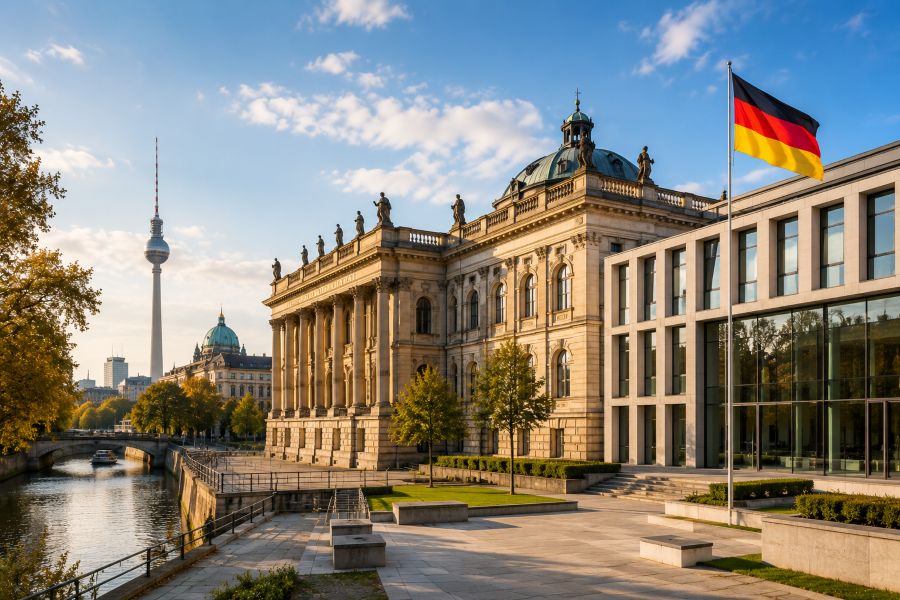

MBA in Germany
Table of Contents
- Why choose MBA in Germany
- Top colleges for Masters in MBA in Germany
- Year-wise Curriculum for MBA in Germany
- Eligibility Requirements for MBA in Germany
- MBA in Germany's Tuition Fees for International Students
- Semester Date & Academic calendar
- How to Apply for MBA in Germany
- Cost of Living in Germany
- Scholarships available for Indian Students in Germany
- Career Opportunities After completing MBA in Germany
- Conclusion
Pursuing an MBA in Germany in 2026 offers an affordable, high-quality alternative to traditional US or UK programs for Indian students. Globally recognized business schools provide 12- to 15-month full-time programs taught entirely in English. Tuition fees typically range from €15,000 (1,611,900 INR) to €50,000 (5,373,000 INR), ensuring an excellent return on investment.
To secure admission, applicants generally need 2–5 years of work experience alongside English proficiency. Most importantly, Germany offers lucrative post-study work visa opportunities, providing Indian professionals a strategic global pathway to launch successful international careers.
Key Highlights:
The program acts as a high-yield strategic investment designed to shift ambitious professionals into elite leadership roles globally, with many German degrees uniquely offering highly affordable education.
This table outlines the fundamental aspects, typical costs, and primary outcomes of an MBA in Germany.
Aspect | Major Details | Equivalent in INR |
Degree Awarded | Master of Business Administration (MBA) | Not Applicable |
Program Duration | Typically, 12 to 24 Months | Not Applicable |
Average Tuition Fees | €15,000 – €50,000 | 1,611,900 INR – 5,373,000 INR |
Top Hiring Sectors | Automotive, Tech, Finance, Consulting | Not Applicable |
Average Base Salary | €61,000 – €140,000 | 6,555,060 INR – 15,044,400 INR |
Post-Study Work Visa | 18-Month Job-Seeker Visa | Not Applicable |
Target Audience | Early to Mid-Career Professionals | Not Applicable |
Work Experience Needed | Typically, 2 to 5 years | Not Applicable |
Why choose MBA in Germany
Studying in Germany for MBA offers unparalleled access to Europe's strongest economy. The country merges highly affordable education with exceptional corporate networking, equipping international students with the strategic skills required to drastically accelerate their global career trajectories.
Affordable Education: Compared to other western nations, Germany offers exceptionally low tuition fees, especially across its prestigious, state-funded public universities.
18-Month Job-Seeker Visa: The German government provides a generous post-study work visa, directly enabling international graduates to stay and search for jobs securely.
Strong Economy & Innovation Hub: Germany is home to massive global corporations and a rapidly expanding digital ecosystem, providing incredibly diverse and lucrative job opportunities.
English-Taught Programs: Most top-tier MBA programs are delivered entirely in English, eliminating the immediate need for German language fluency before enrollment.
High Return on Investment: With highly affordable tuition and starting salaries averaging up to €140,000 (15,044,400 INR), the financial returns are historically massive.
Excellent Work-Life Balance: The German corporate culture heavily prioritizes a healthy work-life balance, ensuring long-term professional sustainability and personal well-being.
Central European Location: Studying in Germany naturally provides a strategic gateway to easily travel and conduct seamless business across the entire European Union.
Top colleges for Masters in MBA in Germany
Germany is home to several prestigious, globally ranked business schools celebrated for their intense academic rigor and powerful corporate partnerships. These leading institutions serve as direct conduits, connecting graduates to top-tier multinational companies and elite consulting firms globally.
This table showcases premier German universities offering an MBA, alongside their program durations and estimated fees.
University | QS World Rankings | Annual Tuition Fees |
ESMT Berlin | #401-450 | €50,000 (5,373,000 INR) |
Mannheim Business School | #104 | €45,000 (4,835,700 INR) |
WHU – Otto Beisheim | #123 | €48,500 (5,211,810 INR) |
Frankfurt School of Finance | #351-400 | €42,000 (4,513,320 INR) |
HHL Leipzig Graduate School | Not featured in QS World Rankings | €41,600 (4,470,336 INR) |
Year-wise Curriculum for MBA in Germany
The German MBA curriculum is intricately structured to transform professionals into versatile, modern leaders. It smoothly transitions from core business fundamentals in the first year to highly specialized electives and practical, industry-driven capstone projects during the final semesters.
Year 1 Curriculum (Core Modules)
The first year establishes a solid, uncompromising management foundation across essential corporate business functions.
Module Category | Key Topics Covered | Academic & Practical Focus |
Financial Foundations | Corporate Finance, Accounting | Mastering financial modeling and understanding complex European capital market strategies. |
Strategy & Operations | Supply Chain, Business Analytics | Optimizing complex global logistics by effectively leveraging advanced, large data structures. |
Organizational Leadership | Organizational Behavior, Marketing | Developing robust, adaptable leadership styles tailored specifically for managing diverse global teams. |
Year 2 Curriculum (Electives & Extended Projects)
The second year allows for deep customization, focusing heavily on industry-specific skills and real-world executive execution.
Module Category | Key Topics Covered | Academic & Practical Focus |
Specialized Electives | Digital Marketing, SEO Strategy | Deep-diving into niche, data-driven sectors like AI marketing, search visibility, and analytics. |
Experiential Immersion | Corporate Consulting Projects | Actively solving live, complex operational problems for actual German enterprises to secure job offers. |
Strategic Capstone | Executive Leadership, Thesis | Synthesizing total academic knowledge to strategically solve massive, real corporate or marketing challenges. |
Eligibility Requirements for MBA in Germany
Securing admission into a competitive German MBA program requires a strong blend of academic excellence, proven professional leadership, and clear intent. Admissions committees meticulously evaluate your tangible career impact and your potential to actively enrich the highly diverse academic cohort.
Academic and Professional Prerequisites
This table details the strict standard academic, professional, and rigorous testing benchmarks required by leading German universities.
Requirement Type | Minimum Benchmark | Detailed Context |
Academic Degree | Bachelor's degree equivalent | Strong undergraduate coursework explicitly showcasing your quantitative and qualitative analytical abilities. |
Professional Experience | 2-5 years of post-graduate work | Business schools heavily prioritize candidates with proven, real-world industry progression and leadership potential. |
Standardized Testing | GMAT (600+) or equivalent GRE | High standardized test scores are utilized to definitively prove your rigorous analytical and mathematical skills. |
Language Fluency | IELTS (6.5+) or TOEFL (90+) | While basic German (A1) is a distinct advantage, certified English fluency is strictly required for admission. |
Application Documents | SOP, CV, and two LORs | Your narrative must securely source professional recommendations and clearly highlight past quantifiable impacts. |
MBA in Germany's Tuition Fees for International Students
An MBA in Germany is an incredibly strategic educational investment, with private institutions charging premium fees while public universities remain highly affordable. Understanding the precise cost breakdown is vital for your comprehensive long-term financial and personal daily living planning.
Tuition fees at different colleges
Tuition fees vary significantly depending on whether the business institution is publicly funded by the state or entirely private.
University | Annual Tuition Fees (EUR) | Annual Tuition Fees (INR approx.) |
ESMT Berlin | €50,000 | 5,373,000 INR |
WHU – Otto Beisheim | €48,500 | 5,211,810 INR |
Mannheim Business School | €45,000 | 4,835,700 INR |
Frankfurt School of Finance | €42,000 | 4,513,320 INR |
EU Business School | €32,000 | 3,438,720 INR |
Semester Date & Academic calendar
German universities naturally operate on strict academic calendars, predominantly welcoming major MBA cohorts during the Winter or Summer semesters. Tracking these non-negotiable administrative deadlines is completely critical for ensuring smooth student visa processing and successfully securing your mandatory blocked accounts.
Key Intake Timelines and Deadlines
The structured academic year is typically divided into two main, highly regulated national intake periods: Winter and Summer.
Academic Event | Expected Timeline | Key Action Required |
Winter Intake (Primary) | Classes begin September/October | Round 1 applications are due around March; Round 2 documentation must be completed by May. |
Summer Intake (Secondary) | Classes begin March/April | Applications are typically due securely between September and November of the preceding year. |
Visa Application Window | Up to 3-4 months before start | Apply for your national student visa immediately once you receive your official university admission letter. |
How to Apply for MBA in Germany
The application process is a highly introspective journey demanding candidates to clearly articulate their professional, unique brand. Beyond just submitting raw testing scores, you must carefully craft a compelling narrative that vividly proves you belong in Germany's highly competitive academic ecosystem.
Step-by-Step Application Guide:
Following a tightly structured, methodical pathway is essential to ensure your German MBA application is thoroughly robust and ultimately successful.
Application Step | Action Required | Essential Details |
1. University Selection | Shortlist 4-5 target programs | Carefully align your specific university choices directly with your ultimate long-term corporate career goals. |
2. Standardized Tests | Clear GMAT/GRE and IELTS | Secure highly competitive scores at least six full months prior to the institution's official deadlines. |
3. Document Preparation | Format CV, SOP, and LORs | Directly highlight specific, quantifiable leadership impacts from your past professional work experiences clearly. |
4. Submit Application | Use Uni-Assist or Portals | Ensure absolutely all verified, translated documents are successfully uploaded long before the deadline hits. |
5. Financial Security | Deposit €11,904 (1,279,203 INR) | Open a mandatory German blocked account to securely prove your financial stability for your visa. |
Cost of Living in Germany
Aside from tuition, you must meticulously budget for your day-to-day survival, and lifestyle needs while living in Germany. The mandatory blocked account system currently requires a minimum deposit of €11,904 (1,279,203 INR) annually to ensure you can adequately cover these ongoing costs.
Category of Expenses: Transportation, Groceries, Accommodation and other essentials
Monthly living expenses vary wildly depending on whether you reside in an expensive hub like Munich or cheaper regional cities.
Expense Category | Annual Cost in EUR | Annual Cost in INR (approx.) |
Accommodation (Student Housing) | €4,800 - €7,200 | 515,808 - 773,712 INR |
Groceries and General Living | €2,400 - €3,000 | 257,904 - 322,380 INR |
Transportation (Semester Ticket) | €300 - €500 | 32,238 - 53,730 INR |
Health Insurance (Public) | €1,300 - €1,500 | 139,698 - 161,190 INR |
Basic Utilities & Internet | €600 - €900 | 64,476 - 96,714 INR |
Source: Numbeo
Scholarships available for Indian Students in Germany
German institutions and government bodies offer highly generous financial aid to ensure elite education remains easily accessible. Securing these highly competitive awards dramatically reduces your financial burden while simultaneously elevating your professional prestige within the competitive global corporate network.
Top Scholarships for Indian Students
Numerous high-value, highly competitive scholarships are explicitly available to strictly assist Indian candidates studying in Germany.
Scholarship Name | Eligibility Criteria | Coverage & Key Details |
DAAD Scholarships | Outstanding professionals from developing nations. | Offers a monthly living stipend of €992 (106,600 INR) alongside comprehensive travel allowances. |
ESMT Women's Scholarship | Exceptional female candidates showing proven leadership. | Partially or fully covers the highly intensive MBA tuition fees strictly at ESMT Berlin. |
WHU Excellence Scholarship | Candidates with outstanding academic & GMAT scores. | Grants a direct, substantial reduction of the overall tuition fees for the entire MBA program. |
Deutschlandstipendium | High-achieving global students displaying civic engagement. | Provides €300 (32,238 INR) per month, funded jointly by the government and private corporate sponsors. |
Heinrich Böll Foundation | Outstanding academic records and strong social engagement. | Grants a comprehensive monthly stipend designed to completely cover all daily student living costs. |
Career Opportunities After completing MBA in Germany
Graduating from a top German business school opens direct doors to highly sought-after executive roles globally. Companies aggressively recruit MBA graduates for their strategic problem-solving abilities, rewarding them with rapid promotions, exceptional financial compensation, and accessible pathways to long-term European residency.
High-Paying Job Roles and Employers
Germany's massive industrial and digital technology sectors offer incredibly lucrative, diverse pathways for ambitious business graduates.
Target Job Role | Estimated Salary Range | Key Employers |
Digital Marketing Manager | €65,000 - €95,000 / 6,984,900 - 10,208,700 INR | Google, Meta, SAP, Amazon, Zalando |
Management Consultant | €70,000 - €120,000 / 7,522,200 - 12,895,200 INR | McKinsey, BCG, Bain, Roland Berger, Deloitte |
Product Manager | €65,000 - €95,000 / 6,984,900 - 10,208,700 INR | SAP, Siemens, Amazon, Google, Meta |
Finance Manager | €70,000 - €100,000 / 7,522,200 - 10,746,000 INR | Deutsche Bank, Allianz, KPMG, Goldman Sachs |
SEO Strategist | €55,000 - €85,000 / 5,910,300 - 9,134,100 INR | Trivago, Delivery Hero, HelloFresh, Auto1 |
Operations Head | €75,000 - €110,000 / 8,059,500 - 11,820,600 INR | DHL, Bosch, Mercedes-Benz, Airbus, Uber |
Source: Glassdoor
Conclusion
An MBA in Germany represents a transformative educational investment that directly bridges raw ambition with elite global leadership. By seamlessly merging rigorous academic theory with intense, real-world applications within Europe's largest economy, this degree allows professionals to rapidly reap massive career benefits. Choosing to study in Germany grants invaluable access to top-tier industry networks, cutting-edge corporate strategies, and the highly coveted 18-month job-seeker visa. Whether your ultimate goal is to excel in digital marketing or to drive innovation across diverse tech sectors, a German MBA completely equips you with the strategic expertise and perspective necessary to thrive successfully internationally today.
Ready to embark on your MBA journey in Germany? Connect with our experts to know about concerned universities, courses, scholarships, admissions, and career opportunities.
Popular course(s) provides by top universities abroad:
MS in Health Services Administration Abroad in 2026