
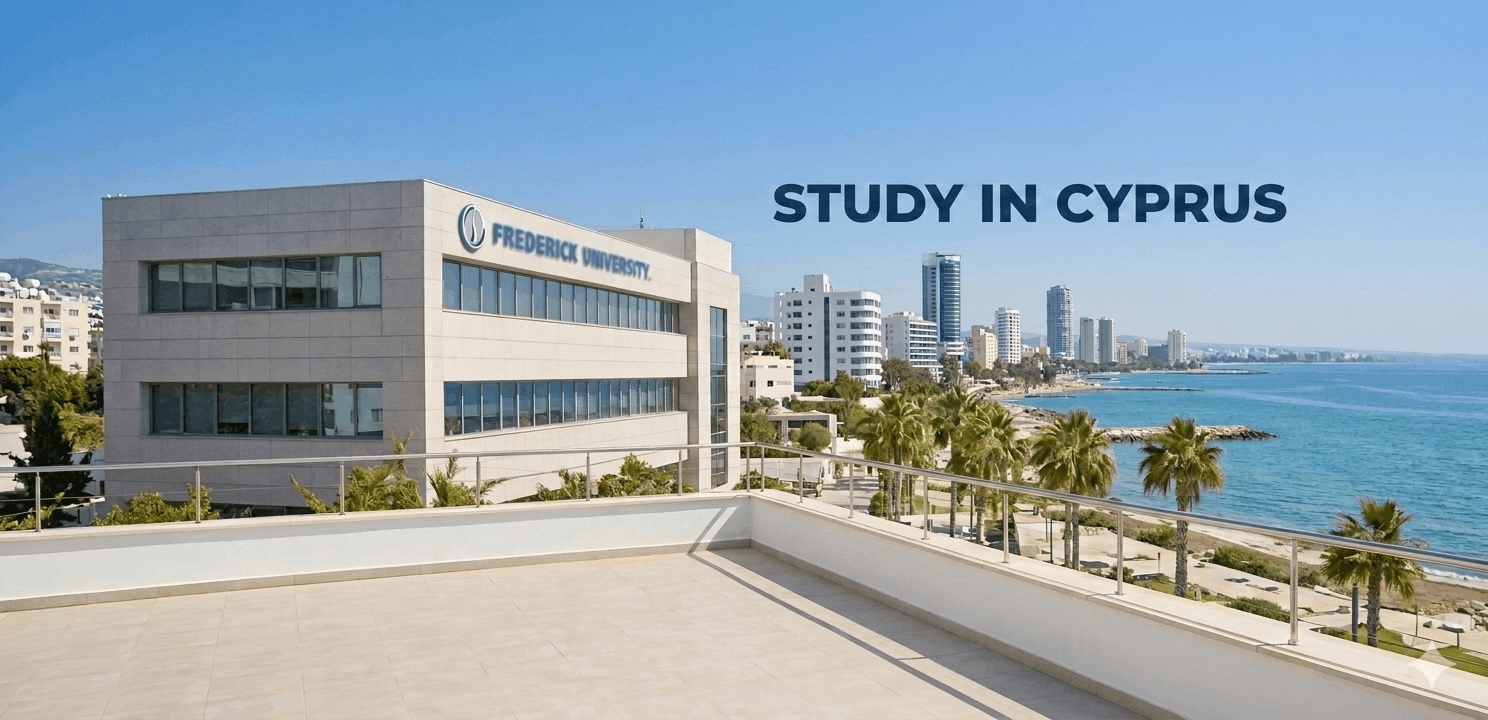
Study in Cyprus
Table of Contents
- Why Study in Cyprus?
- Top Universities for Study in Cyprus
- Popular Courses for Study in Cyprus
- Course Structure for Study in Cyprus
- Eligibility and Admission Requirements for Study in Cyprus
- Tuition Fees for Study in Cyprus
- Cost of Living in Cyprus for International Students
- Top Scholarships for Study in Cyprus
- Intakes and Application Timeline for Study in Cyprus
- Student Visa Requirements for Study in Cyprus
- Top Cities to Study in Cyprus
- Top Job Opportunities After Study in Cyprus
- Conclusion
Study in Cyprus offers an affordable, high-quality European education, with popular programmes available across business, hospitality, computer science, and medicine. Annual tuition fees range from EUR 4,000 to EUR 25,000 (approx. Rs. 3.6L to Rs. 22.5L) depending on the institution and programme level, making Cyprus one of the more cost-effective EU destinations for international students.
Living costs average EUR 500 to EUR 750 per month (approx. Rs. 45,000 to Rs. 67,500 per month), varying by city and lifestyle. International students can work part-time during their studies and often have access to post-study options after graduation, making Study in Cyprus a practical choice in 2026.
Key Highlights of Study in Cyprus:
Key Highlights | Details |
Course Duration | 3 to 4 years undergraduate; 1 to 2 years postgraduate; 3 to 4 years PhD |
Course Types | Bachelor's, Master's, MBA, PhD, Medicine (MD) |
Top Universities | University of Cyprus, Cyprus University of Technology, University of Nicosia, Cyprus International University |
Popular Fields | Business, Medicine, Computer Science, Engineering, Hospitality, Law |
Tuition Fees (Public Universities) | EUR 4,000–9,000/year (approx. Rs. 3.6L–Rs. 8.1L) |
Tuition Fees (Private Universities) | EUR 6,000–25,000/year (approx. Rs. 5.4L–Rs. 22.5L) |
Living Expenses | EUR 6,000–9,000/year (approx. Rs. 5.4L–Rs. 8.1L) |
Language of Instruction | English and Greek; most international programmes in English |
Visa Type | Temporary residence permit via Civil Registry and Migration Department |
Part-Time Work Rights | Up to 20 hours/week during term |
Main Intake | September (primary); February available at select universities |
Why Study in Cyprus?
There are practical reasons beyond cost that make Study in Cyprus a strong choice for international students. Here is what consistently draws students toward Cyprus universities.
English-Medium Degrees at Scale: Most postgraduate and undergraduate programmes for international students are delivered entirely in English across both public and private universities, removing the need for Greek language skills.
EU-Wide Degree Recognition: As an EU member state since 2004, degrees from accredited Cyprus institutions carry recognition across all 27 EU member states, giving graduates flexibility for further study or employment elsewhere in Europe.
Strength in Specific Sectors: Cyprus has built genuine academic strength in medicine, shipping and maritime management, and financial services, supported by its position as a regional business hub in the Eastern Mediterranean.
Lower Tuition Costs: Tuition fees remain considerably lower than equivalent programmes in the UK, Netherlands, or France, particularly at public universities, making Cyprus a cost-effective EU option.
Manageable Cost of Living: The overall cost of living is more manageable than most Western European destinations, especially outside Nicosia, helping students balance quality against budget.
Faster Admissions Process: International students benefit from a relatively quick admissions process, with many universities responding within two to four weeks of receiving a complete application.
Top Universities for Study in Cyprus
Cyprus runs a two-track higher education system made up of public universities and private institutions, each with distinct strengths. Comparing accreditation, programme focus, and location matters before shortlisting.
University | Type | Approx. Annual Tuition (International) |
University of Cyprus | Public | EUR 4,000–7,000 (approx. Rs. 3.6L–Rs. 6.3L) |
Cyprus University of Technology | Public | EUR 4,000–8,000 (approx. Rs. 3.6L–Rs. 7.2L) |
University of Nicosia | Private | EUR 7,000–25,000 (approx. Rs. 6.3L–Rs. 22.5L) |
Cyprus International University | Private | EUR 6,000–14,000 (approx. Rs. 5.4L–Rs. 12.6L) |
European University Cyprus | Private | EUR 7,000–22,000 (approx. Rs. 6.3L–Rs. 19.8L) |
Frederick University | Private | EUR 6,000–12,000 (approx. Rs. 5.4L–Rs. 10.8L) |
Open University of Cyprus | Public | EUR 4,000–6,000 (approx. Rs. 3.6L–Rs. 5.4L) |
Popular Courses for Study in Cyprus
Cyprus has built particular academic strength in business, medicine, computer science, hospitality, and law. Most international programmes run entirely in English, making them accessible without Greek language skills.
Field of Study | Popular Programmes |
Business and Management | MBA, MSc Management, MSc Finance, MSc Shipping and Maritime Management |
Medicine and Health Sciences | MD, BSc Nursing, MSc Public Health, BSc Pharmacy, MSc Dentistry |
Computer Science and Engineering | MSc Computer Science, MSc Data Science, MSc Civil Engineering, MSc Cybersecurity |
Hospitality and Tourism | BSc Hospitality Management, MSc Tourism Management |
Law | LLM International Law, LLM European Law |
Course Structure for Study in Cyprus
Programmes in Cyprus generally follow a two-phase format across most disciplines. The first phase builds theoretical foundations, while the second focuses on specialisation and applied or research components.
General Course Structure
Most degrees in Cyprus combine core theory with a practical or research component. This structure applies across business, science, and health disciplines alike.
Programme Stage | Key Components |
Core Modules | Subject-specific theory, quantitative methods, foundational coursework |
Specialisation Track | Elective courses aligned with career or research direction |
Practical Component | Internship, clinical placement, lab work, or applied project depending on discipline |
Thesis or Research Project | Final dissertation or capstone project at most postgraduate programmes |
Top Specialisations for Study in Cyprus
Cyprus offers focused specialisations tied closely to its key industries. These programmes are designed around genuine local and regional employment demand.
Specialisation | Universities Known For It |
Shipping and Maritime Management | Cyprus University of Technology, University of Nicosia |
Medicine (MD) | University of Nicosia, European University Cyprus |
Financial Services and Banking | University of Nicosia, Cyprus University of Technology |
Hospitality and Tourism Management | Cyprus University of Technology, Frederick University |
Eligibility and Admission Requirements for Study in Cyprus
Admission requirements for Study in Cyprus are broadly consistent across public and private institutions. Specific expectations shift depending on programme level and university tier.
Academic Qualification Requirements
Academic eligibility depends on the programme level and the student's prior qualification. Requirements are generally comparable to standards seen across the wider EU.
Programme Level | Academic Requirements |
Undergraduate (Bachelor's) | Completed 12th standard or equivalent with minimum 60 percent or equivalent |
Postgraduate (Master's) | Four-year bachelor's degree with minimum 55 to 65 percent or equivalent |
Medicine (MD) | Strong performance in biology, chemistry, and physics; entrance exam at select universities |
PhD | Master's degree in a relevant field; research proposal required |
English Language Proficiency Requirements
Cyprus does not require Greek language ability for most English-taught programmes. All non-native English speakers must demonstrate proficiency through a recognised test.
University Tier | IELTS Academic | TOEFL iBT |
Public Universities | 6.0 to 6.5 | 75 to 90 |
Private Universities | 5.5 to 6.5 | 70 to 90 |
Medicine Programmes | 6.0 to 6.5 | 80 to 90 |
Tuition Fees for Study in Cyprus
Tuition fees for Study in Cyprus depend heavily on institution type and programme level. Public universities sit at the more affordable end, while private institutions and medicine programmes cost considerably more.
Course Type | Approximate Annual Tuition Fees | INR Value |
Public Universities (Bachelor's) | EUR 4,000–7,000/year | Rs. 3.6L–Rs. 6.3L/year |
Public Universities (Master's) | EUR 4,000–8,000/year | Rs. 3.6L–Rs. 7.2L/year |
Private Universities (Bachelor's) | EUR 6,000–14,000/year | Rs. 5.4L–Rs. 12.6L/year |
Private Universities (Master's) | EUR 6,000–16,000/year | Rs. 5.4L–Rs. 14.4L/year |
MBA Programmes | EUR 8,000–18,000/year | Rs. 7.2L–Rs. 16.2L/year |
Medicine (MD) Programmes | EUR 9,000–25,000/year | Rs. 8.1L–Rs. 22.5L/year |
Cost of Living in Cyprus for International Students
Living costs in Cyprus vary by city, housing type, and lifestyle. Nicosia, Limassol, and Larnaca are the most popular student cities, with Nicosia generally being slightly more affordable.
Expense Category | Approx. Monthly Cost | INR Value |
Accommodation | EUR 250–450/month | Rs. 22,500–Rs. 40,500/month |
Food and Groceries | EUR 150–250/month | Rs. 13,500–Rs. 22,500/month |
Transport | EUR 30–60/month | Rs. 2,700–Rs. 5,400/month |
Health Insurance | EUR 20–40/month | Rs. 1,800–Rs. 3,600/month |
Total Annual Living Cost | EUR 6,000–9,000/year | Rs. 5.4L–Rs. 8.1L/year |
Visa Financial Requirement: Non-EU students must demonstrate proof of approximately EUR 7,000 to EUR 10,000 (approx. Rs. 6.3L to Rs. 9L) in financial resources for one academic year, in addition to tuition fees, when applying for the student visa.
Top Scholarships for Study in Cyprus
International students pursuing Study in Cyprus can access several scholarships that reduce tuition and living costs. Eligibility and award value vary considerably by university and programme type.
Scholarship | Eligibility | Coverage |
Cyprus Government Scholarships | International students from countries with bilateral agreements; strong academic record | Full or partial tuition; varies by agreement |
University of Nicosia Merit Scholarships | Admitted students with strong academic performance | Up to 50 percent tuition reduction |
Cyprus International University Scholarships | International students; merit and need-based criteria | Partial tuition reduction; varies by programme |
European University Cyprus Scholarships | Admitted students with strong academic record | Partial tuition reduction; varies by programme |
Erasmus+ Programme | Students from EU partner institutions on exchange | Tuition waiver and mobility grant for exchange period |
Intakes and Application Timeline for Study in Cyprus
Most Cyprus universities offer two intakes: September as the primary intake and a limited February intake at select institutions. Students should begin applying 6 to 8 months in advance.
Intake | Programme Start | Application Timeline |
September (Main) | September | Applications open year-round; deadlines vary by university |
February (Limited) | February | Available at select programmes; check directly with university |
How to Apply for Study in Cyprus
Applying for Study in Cyprus involves shortlisting universities, checking eligibility, preparing documents, and submitting applications through official portals before arranging the visa and travel.
Step | What to Do |
Step 1: Shortlist Universities | Select based on programme, fees, location, and accreditation |
Step 2: Check Eligibility | Review academic and English language requirements |
Step 3: Prepare Documents | Gather transcripts, SOP, LORs, CV, and passport |
Step 4: Submit Application | Apply via the university's official admissions portal |
Step 5: Receive Offer Letter | Universities typically respond within 2 to 4 weeks |
Step 6: Apply for Student Visa | Submit visa application with offer letter and financial proof |
Step 7: Arrange Pre-Departure | Book accommodation, organise health insurance, prepare travel documents |
Student Visa Requirements for Study in Cyprus
International students from outside the EU admitted to a Cyprus university must apply for a temporary residence permit before travelling, typically through the Civil Registry and Migration Department.
Requirement | Detail | Approx. Amount |
Official Offer Letter | From a recognised Cyprus institution | Required |
Visa Application Fee | Paid at time of application | EUR 70–100 (approx. Rs. 6,300–Rs. 9,000) |
Proof of Financial Resources | Tuition and living costs for the academic year | EUR 7,000–10,000/year (approx. Rs. 6.3L–Rs. 9L/year) |
Medical Insurance | Required for the duration of stay | EUR 20–40/month (approx. Rs. 1,800–Rs. 3,600/month) |
Police Clearance Certificate | Required for most applicants | Required |
Academic Documents | Transcripts, degree certificates, language test scores | Required |
Top Cities to Study in Cyprus
City selection shapes both living costs and post-graduation opportunities. Cities with strong industry presence offer the best environment for international students in Cyprus, and each major city brings a distinct mix of academic options, career exposure, and day-to-day affordability worth weighing before choosing where to study.
City | Why It is Preferred |
Nicosia | Capital city; home to University of Cyprus; strongest financial services, government, and corporate job market on the island |
Limassol | Major shipping, tourism, and business hub; University of Nicosia satellite presence; strong international corporate community |
Larnaca | Coastal city with growing student population; home to Cyprus's main international airport; lower living costs than Limassol |
Paphos | Smaller, quieter city; growing tourism sector; noticeably lower living costs than Nicosia or Limassol |
Top Job Opportunities After Study in Cyprus
Cyprus offers graduates access to financial services, shipping, technology, and healthcare sectors, both locally and across the wider EU through degree recognition. The country's role as a regional business and shipping hub, combined with a growing technology sector, gives graduates a reasonably broad range of career paths to choose from after completing their studies.
Job Sector | Approximate Annual Salary | INR Value |
Financial Services | EUR 25,000–45,000 | Rs. 22.5L–Rs. 40.5L |
Shipping and Maritime | EUR 25,000–50,000 | Rs. 22.5L–Rs. 45L |
Information Technology | EUR 22,000–42,000 | Rs. 19.8L–Rs. 37.8L |
Healthcare and Medical | EUR 25,000–48,000 | Rs. 22.5L–Rs. 43.2L |
Hospitality and Tourism | EUR 18,000–32,000 | Rs. 16.2L–Rs. 28.8L |
Conclusion
Study in Cyprus combines EU-recognised degrees, English-medium instruction, and tuition fees considerably lower than most Western European destinations. With strong programmes in medicine, shipping, business, and technology, plus a manageable cost of living outside Nicosia, Cyprus offers genuine value for students balancing academic quality against budget in 2026.
Planning to Study in Cyprus? Speak with our study abroad experts for personalised guidance.